
Blocking a two-hander when the frame holds one
The portrait screen fits one person comfortably. The scene has two. Every solution to that arithmetic is a piece of film grammar the format is writing right now.
Listen to this story
3 min listen
Two people are talking. In widescreen this is the most solved problem in cinema — shot, reverse shot, occasional two-shot to re-establish the room. In portrait, the two-shot barely exists. The frame holds one person comfortably, two people only in intimacy or confrontation. So what does a vertical conversation look like?
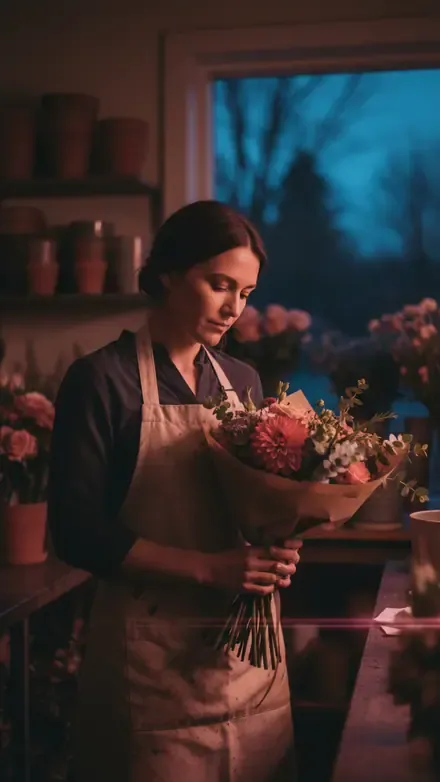
Watch enough of the current slate and four answers keep recurring. The stacked two-shot: one face above the other — a staircase, a bunk, a window and a street — turning vertical space into power dynamics. The over-shoulder crowd: the second character reduced to an ear, a jaw, a presence at the frame’s edge, the conversation staged almost entirely on one listening face. The handoff: a single fluid move that gives the frame to whoever holds the scene’s power, making the cut itself a dramatic beat. And the shared frame, saved like a chord change for the moment the scene turns — in Bloom, the florist and the widower do not appear together in a single frame until the final scene, and the composition lands like a kiss precisely because the grammar made us wait for it.
Each solution carries its own acting problem, and the over-shoulder crowd is the revealing one. Staging a conversation on the listener means the speaking performance happens off-camera — a generosity broadcast actors are rarely asked for. Casts that came up through theatre take to it instantly; they have played scenes to the back of someone’s head before. The format is quietly re-sorting which training pipelines produce its leads, and nobody planned that.
Entrances into the rectangle are events. The cut itself becomes a dramatic beat.
The editors have the other half of the grammar. In widescreen, a conversation’s rhythm lives in the alternation of angles; in portrait, with fewer angles available, rhythm moves into duration — how long a face is allowed to hold before the frame is surrendered. The strongest vertical editors talk about “possession time” like football analysts, and cutting on the reaction rather than the line stops being a style and becomes the default, because the reaction is usually the only other shot that exists.
The deeper point is that these are not compromises. Widescreen coverage was also a convention once, built to solve its own rectangle. The directors doing the best vertical work treat the narrow frame the way sonnet writers treat fourteen lines — not as the obstacle, but as the reason the form has a voice at all.
If the format produces a canon, its first entries will be scenes like these: two people, one narrow frame, and a solution nobody had filmed before.